The weakest link in a system
Earth AbidesThe weakest link in a system is the point where a network’s apparent resilience depends on a component, inspection, or repair that cannot sustain itself. In the novel, power and water systems initially continue to function after the Great Disaster, but their carefully managed complexity cannot replace the people who maintained them. A single fault can therefore grow from a local inconvenience into a failure with consequences far beyond its point of origin.
Redundancy and hidden maintenance
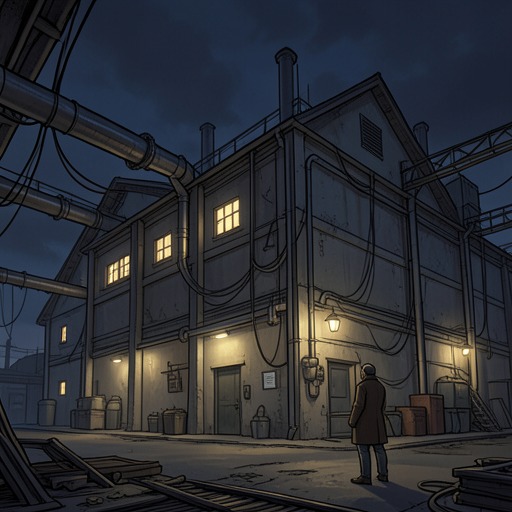
The Power-and-Light system was designed to compensate automatically for certain disruptions. If a wire broke and cut off a town, the network adjusted before the wire fell; if a power-house failed, others across hundreds of miles took up the load. Even after people fell sick and died, the generators continued sending power through the wires. The apparent self-sufficiency was real, but limited: it could handle interruptions within the system, not the disappearance of the labor that kept its components in working order.
The vulnerability lay in the generators’ governors. They were inspected for oil every ten days, and might need additional oil about once a month; they were not wholly automatic. After two months without attention, oil supplies dwindled and the governors began failing one by one. Each failure redirected water through a nozzle without turning the generator’s wheel, stopping that generator from producing power. As more units dropped out, the remaining generators carried increasing strain, and the decline became cumulative. The lights could persist for weeks after the human catastrophe, yet their continued operation only delayed the consequences of an unmaintained system.
The aqueduct’s cascading failure
The water system’s weakness is embodied in a particular steel section of the main aqueduct. Manufacturing imperfections had been noticed, but the section passed inspection at the end of a workday, when the inspector’s judgment was impaired. It was installed and initially worked without difficulty. Shortly before the disaster, a foreman noticed a small leak; welding a patch appeared to make the pipe as good as new, or stronger than average. The repair addressed the visible defect, but no one returned to inspect the section in the years that followed.
The leak enlarged gradually. A green patch appeared beneath the pipe even in dry summers, attracting birds and small animals. After five or ten years, a dozen fine jets sprayed from the pipe, and cattle drank from the puddle below. Five years later, a small stream ran there through an otherwise dry foothill region. Meanwhile, rust weakened the steel from outside and corrosion worked from within. The animals’ trampling helped erode the soft, wet ground beneath the pipe’s concrete support. When the erosion finally triggered a mudflow, the pier settled and the heavy water load shifted onto the weakened pipe. A long tear opened; the escaping water further undermined the footing, the pier shifted again, and the rupture widened until the outflow became like a small river. The disaster arose not from one sudden defect alone, but from a chain in which unattended leakage, erosion, structural weakness, and redirected load reinforced one another.
Small blockages, large consequences
The same principle appears on San Lupo Drive at a smaller scale. After rain, unswept leaves plugged a drain-pipe. Water crossed the street, spilled over the curb, ran through tall grass that had been a lawn, entered a house, and cut a small gully through a garden before reaching a storm sewer. Ish recognizes that the incident is minor in itself, but sees it as evidence of what is happening across the country. Roads, drains, and walls obstruct the natural movement of water; their continued usefulness depends on people clearing blockages and repairing small failures as they appear. He could have scraped the leaves away from the grate in two minutes, but sees no point in acting at just one of the thousands or millions of places where similar failures must be occurring.
Water loss also gathers across the larger network. Heavy rains after New Year’s slow the fall of the Reservoir’s level, but an unusually early midwinter dry spell follows. Water continues to escape through open faucets, leaking joints, and broken pipes. The gauge had recently shown a depth of twenty feet; now only a thin layer covers the bottom. The declining supply makes visible the combined effect of countless leaks, rather than a single dramatic break.
What the failures reveal
Across these episodes, the weakest link is not necessarily the most conspicuous or dramatically damaged part. It may be a governor that needs oil, a pipe whose repair is never checked again, or a drain that needs leaves cleared away. The systems’ design can absorb some failures, but that resilience depends on continued human observation and intervention. Once those routine tasks cease, small defects have time to connect and compound.
The novel thus treats infrastructure as a network of dependencies rather than as a collection of durable objects. A generator, aqueduct, or drain may appear to function independently of its users, but its reliability rests on inspections, repairs, and cleaning that are easy to overlook while they are performed. After people disappear, the system’s weakest link is often the missing maintenance itself: a modest need repeated across many sites until the network can no longer deliver the service on which its users depended.